Maintaining consistent playing conditions across a golf course requires more than one mowing strategy. Greens, fairways, tees, roughs, and surrounds each place different demands on equipment, operators, and maintenance schedules.
John Deere offers dedicated mowers for each application, from walk greens mowers built for precision to high-capacity fairway mowers designed for productivity. Matching the right mower to each application helps maintain consistent playing conditions while improving crew productivity.
This guide explains the different types of John Deere golf mowers, where they’re typically used, and the factors to consider when selecting the right equipment for your course.

Key Takeaways
- John Deere offers specialized golf mowers for fairways, greens, tees, roughs, surrounds, and other course areas.
- Most golf courses need multiple mower categories to meet the requirements of different playing surfaces.
- Course layout, turf conditions, mowing frequency, and productivity goals should guide mower selection.
- Turf sprayers, utility vehicles, bunker and field rakes, and aeration equipment can round out a course maintenance fleet.
What are John Deere Golf Mowers?
John Deere golf mowers are specialized turf maintenance machines designed for different areas of a golf course, including greens, fairways, and tees. Because each area has different cutting heights, terrain, and maintenance needs, most golf courses rely on multiple mower types rather than a single machine.
Each mower category is built for a specific application. Fairway mowers maximize productivity across large, open areas, while walk greens mowers deliver the precision needed for closely maintained turf. Rough, trim, and surrounds mowers are built to navigate less uniform terrain and transitional areas.
Using the right mower for each application can improve cut quality, reduce maintenance time, and help crews care for the course more efficiently.
What Types of John Deere Golf Mowers Are Available?
To meet the maintenance needs of different course areas, John Deere offers several dedicated mower categories, including:
- Fairway mowers
- Walk greens mowers
- Rough, trim, and surrounds mowers
- Triplex mowers
John Deere Fairway Mowers for Large, Open Turf Areas
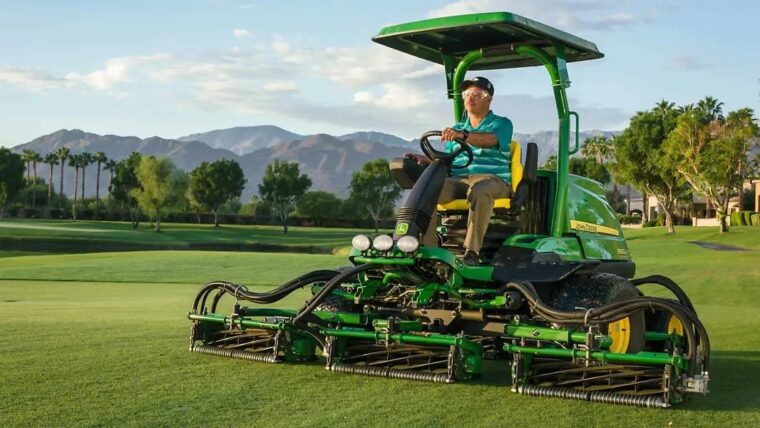
What are they? Mowers engineered to maintain large acreages of closely mowed turf at consistent heights of cut while maximizing operator productivity.
Common uses: Fairways and other large, open turf areas where crews need to mow significant acreage efficiently.
When they’re a good fit: Courses with large fairway acreages benefit from fairway mowers. Wider cutting widths and multiple reel configurations allow crews to cover more ground in less time while maintaining a consistent cut.
Models: PrecisionCut™ Fairway Mowers
John Deere fairway mowers are available in two configurations: PrecisionCut™ and E-Cut™ Hybrid. PrecisionCut™ models use a traditional hydraulic reel drive system, making them a familiar option for courses that prefer conventional reel technology.
| Model | Engine power (hp/kW) | Cutting width | Best suited for |
| 6700A PrecisionCut™ | 24.7 hp (18.4 kW) | 100 in. | Smaller courses and tighter fairway layouts |
| 7700A PrecisionCut™ | 41.6 hp (31.0 kW) | 100 in. | Larger fairway acreages and demanding mowing schedules |
| 8700A PrecisionCut™ | 55.1 hp (41.1 kW) | 100 in. | High-volume fairway maintenance programs |
| 8900A PrecisionCut™ | 55.1 hp (41.1 kW) | 114 in., 130 in. | Maximum acreage coverage and fewer mowing passes |
Models: E-Cut™ Hybrid Fairway Mowers
John Deere E-Cut™ Hybrid fairway mowers use electric reel motors powered by an onboard generator instead of traditional hydraulic reel drives. By eliminating hydraulic leak points within the reel drive circuit, this design helps reduce the risk of hydraulic leaks on closely maintained turf.
| Model | Engine power (hp/kW) | Cutting width | Best suited for |
| 6080A E-Cut™ Hybrid | 24.7 hp (18.4 kW) | 80 in. | Courses seeking hybrid technology with a narrower cutting width |
| 6700A E-Cut™ Hybrid | 24.7 hp (18.4 kW) | 100 in. | Balancing hybrid operation with increased fairway coverage |
| 7700A E-Cut™ Hybrid | 41.6 hp (31.0 kW) | 100 in. | Larger fairway mowing programs requiring additional power |
| 8000A E-Cut™ Hybrid | 41.6 hp (31.0 kW) | 80 in. | Courses prioritizing hybrid technology, power, and maneuverability |
Additional 6500A and 7500A configurations are available for courses requiring different reel and mowing characteristics.
John Deere Walk Greens Mowers for Detailed Turf Care
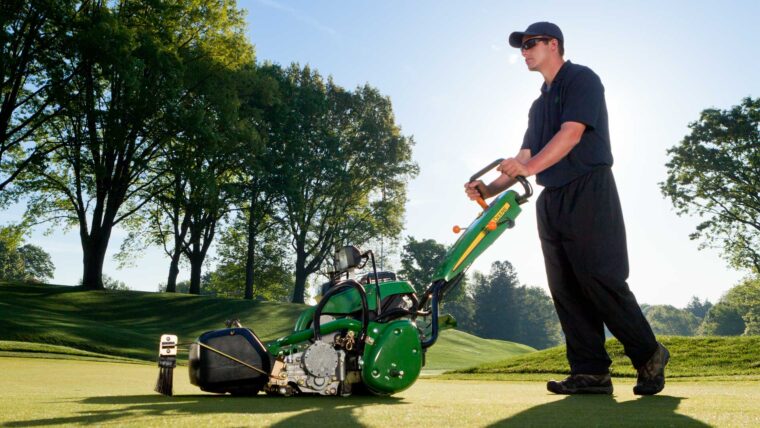
What are they? Walk-behind reel mowers designed for highly maintained turf where precise operator control and consistent cut quality are priorities.
Common uses: Putting greens and other areas maintained at very low mowing heights.
When they’re a good fit: Walk greens mowers are a good choice for courses that prioritize maximum control and a traditional greens mowing approach. Their walk-behind design gives operators greater control over the quality of cut while allowing the mower to closely follow green contours. John Deere also offers battery-electric walk greens mower options for courses pursuing reduced fuel consumptions and emissions.
Discover John Deere Walk Greens Mowers
| Model | Engine hp | Cutting width | Best suited for |
| 180 E-Cut™ Hybrid | 3.2 hp | 18 in. | Hybrid operation on smaller greens and detailed turf areas |
| 220 E-Cut™ Hybrid | 3.2 hp | 22 in. | Increased productivity on courses maintaining multiple greens |
| 180 SL PrecisionCut™ | 3.2 hp | 18 in. | Traditional greens mowing with maximum maneuverability |
| 220SL PrecisionCut™ | 3.2 hp | 22 in. | Balancing control and productivity across routine greens maintenance |
| 260SL PrecisionCut™ | 3.2 hp | 26 in. | Larger greens and crews seeking greater mowing productivity |
John Deere Rough, Trim, and Surrounds Mowers for Challenging Course Areas

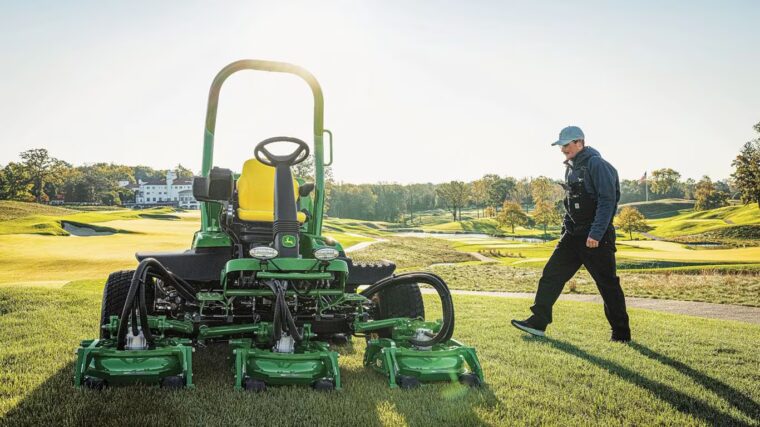
What are they? Mowers built for roughs, surrounds, slopes, and other areas where terrain and changing turf require greater maneuverability.
Common uses: Green surrounds, first-cut rough, primary roughs, bunker edges, mounds, tree lines, and transitional turf areas.
When they’re a good fit: These mowers are well suited for courses with significant slopes, uneven terrain, and other challenging mowing conditions. Depending on the model, features such as stable cutting platforms, terrain-following capability, and wider cutting widths help maintain cut quality while improving productivity.
Explore John Deere Rough, Trim, and Surrounds Mowers
John Deere rough, trim, and surrounds mowers are offered in PrecisionCut™ and TerrainCut™ configurations. PrecisionCut™ models are designed to provide stability and consistent cut quality, while TerrainCut ™ models use contour-following cutting units that help maintain cut quality across rolling terrain and uneven rough areas.
| Model | Engine hp | Cutting width | Best suited for |
| 2653B PrecisionCut™ | 19.6 hp | 72-84 in. | Green surrounds, approaches, first-cut rough, and multi-purpose mowing applications |
| 7200A PrecisionCut™ | 24.7 hp | 68-72 in. | Courses seeking maneuverability around bunkers, tree lines, and other detailed turf areas |
| 7400A TerrainCut™ | 41.6 hp | 68-74 in. | Rough areas with varying terrain and elevation changes |
| 8800A TerrainCut™ | 55.1 hp | 88 in. | High-volume rough mowing programs requiring greater coverage |
| 9009A TerrainCut™ | 55.1 hp | 108 in. | Large courses prioritizing maximum rough-area productivity and fewer mowing passes |
John Deere Triplex Mowers for Versatile Course Maintenance

What are they? Riding reel mowers that use three cutting units and are designed to maintain closely mowed turf across multiple areas of the golf course.
Common uses: Greens, tees, approaches, fairways, and surrounds.
When they’re a good fit: Triplex mowers are a good choice for courses that want the precision of reel mowing with greater versatility and productivity than a walk-behind mower. Unlike walk greens mowers, triplex models are rider-operated and can be used across several course areas. John Deere triplex mowers also feature contour-following systems that help the cutting units adjust to undulations, rolling terrain, and perimeter cuts while maintaining consistent cut quality.
Beyond Mowers: Other John Deere Golf and Sports Turf Equipment to Consider
A complete golf course maintenance program also relies on equipment that supports turf health, course conditions, and daily operations, including:
- Turf Sprayers apply fertilizers, herbicides, fungicides, growth regulators, and other turf treatments with consistent coverage across the course. Consistent application rates help promote healthier turf and more uniform playing conditions.
- Gator™ Turf Utility Vehicles transport tools, materials, irrigation supplies, and maintenance equipment throughout the course. Their turf-friendly design minimizes surface disturbance while helping crews move efficiently between maintenance tasks.
- Bunker and Field Rakes groom sand bunkers and other maintained areas to create smooth, consistent playing surfaces. Motorized models improve efficiency while reducing footprints, tire tracks, and other surface irregularities.
- Aeration Equipment, including John Deere’s Aercore™ aerators and attachments, relieves soil compaction, manages thatch, and encourages stronger root growth. Regular aeration improves the movement of air, water, and nutrients through the soil, supporting healthier turf.
While mowing equipment forms the foundation of course maintenance, most golf facilities rely on additional turf care equipment to maintain playing conditions throughout the seasons.
Find the Right John Deere Golf Mower for Your Course
The best mower lineup depends on your course layout, maintenance priorities, and the types of turf your crews manage every day.
With dedicated equipment for every major mowing application, John Deere offers options for courses of different sizes and maintenance needs. Evaluating each mower’s intended application, cutting width, and key features can help narrow your options and identify the best fit for your maintenance program.
Ready to find the right John Deere golf mower for your course? Explore available equipment on MachineFinder or contact your local John Deere dealer.


John Deere Golf Mowers FAQs
1. How Should a Golf Course Decide Between a Triplex Mower and a Walk Greens Mower?
Triplex mowers help crews maintain greens, tees, and approaches more efficiently, while walk greens mowers offer the level of control many courses require for highly maintained putting surfaces.
2. How Can Course Layout Impact the Type of John Deere Golf Mower You Choose?
Course layout plays a major role in determining the right mower lineup. Large, open fairways often require wider cutting widths, while courses with more slopes, bunkers, and surrounds may prioritize maneuverability.
3. How Do Mowing Frequency and Turf Conditions Influence Mower Selection?
Mowing frequency and turf conditions help determine how much precision and productivity are needed from a mower. Areas maintained at lower mowing heights or mowed more frequently benefit from mowers that deliver a clean, consistent cut without stressing the turf.
4. How Do Cutting Width and Maneuverability Affect Golf Course Mower Performance?
Cutting width and maneuverability affect how efficiently a mower can maintain different areas of a course. Wider cutting widths can improve productivity on large turf areas, while more maneuverable machines are better suited for greens, surrounds, and other confined spaces.
5. How Can Connected Golf Course Management Tools Improve Mowing and Maintenance Decisions?
Connected golf course management tools improve maintenance decisions by providing greater visibility into equipment, labor, and course operations. Access to this information can help course managers plan mowing schedules, track maintenance needs, and allocate resources more effectively.
6. Which John Deere Mower Is Used on Putting Greens?
Walk greens mowers and triplex greens mowers are commonly used on putting greens. The best choice depends on desired cut quality, available labor, and operational efficiency goals.
7. Can One Golf Mower Maintain an Entire Course?
Most golf courses use multiple mower types because greens, fairways, roughs, surrounds, and tees require different mowing heights and operating characteristics.