Tractor tillers are a go-to implement for soil preparation, but choosing the right one isn’t always straightforward. Tiller size, PTO requirements, soil conditions, property scale, and workload all impact how well a tiller performs in the field. John Deere Frontier rotary tillers are available across multiple sizes, duty levels, and configurations to support different soil preparation needs.
Whether you’re maintaining food plots, managing acreage, or preparing seedbeds, the wrong setup can lead to inconsistent results and unnecessary strain on your equipment.
This guide breaks down the key differences between tractor tiller types, sizes, and use cases to help you confidently match the right tiller to your tractor and operation.

Key Takeaways
- Tractor tillers are PTO-driven implements that break up and mix soil for seedbed setup and land conditioning.
- Duty level (standard, medium, or heavy-duty depending on manufacturer classification) determines how well a tiller handles different soil conditions and workloads.
- Width, PTO horsepower, and tilling depth all need to align with your tractor to ensure consistent performance.
- Proper sizing matters, as over- or under-matching a tiller to your tractor can reduce efficiency and increase strain.
- Tractor tillers are used across a range of applications, from garden plots to larger land preparation and renovation projects.
What Is a Tractor Tiller?
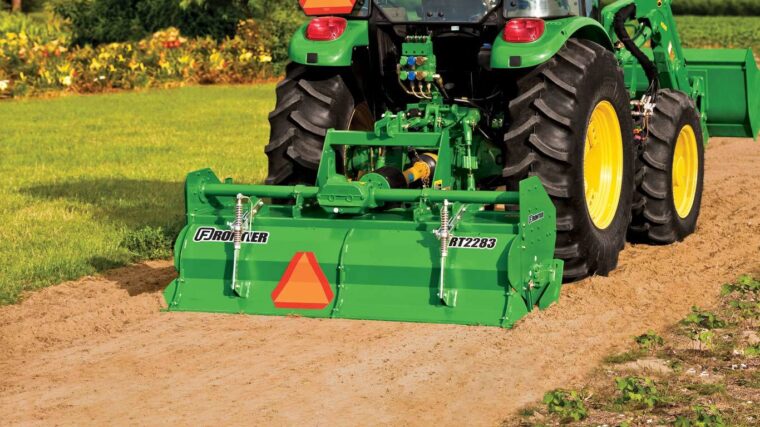
A tractor tiller is a power take-off (PTO)-powered implement that uses rotating tines to break up soil, mix in organic matter, and create a consistent planting surface.
Unlike walk-behind or standalone tillers that use small onboard engines, tractor tillers mount to the tractor, typically through a 3-point hitch, and are powered directly through the PTO. This allows them to work more efficiently across larger areas while maintaining consistent tilling depth and handling tougher soil conditions.
Tillers are used across a range of applications, with smaller models suited for gardening and more contained projects. Larger tractor-mounted tillers, including models in the Frontier rotary tiller lineup, can support broader tasks like seedbed preparation, soil conditioning, and land renovation.
Types of Tractor Tillers
Tractor tillers are often compared by duty level, working width, PTO horsepower requirements, hitch compatibility, and drive system. For John Deere/Frontier models, duty classifications vary by series and model, so it’s important to verify the exact model specifications before matching a tiller to a tractor.
The main categories include:
- Medium-duty rotary tillers: RT12 and RT22 Series
- Standard-duty / compact tractor tillers: RT30 Series
- Specialty/lawn and garden tractor-mounted tillers: 647 rotary tiller and similar 3-point/PTO-mounted models
Medium-Duty Tillers (RT12, RT22 Series)
Medium-duty rotary tillers, such as current RT12 and RT22 models, are designed for seedbed preparation, soil conditioning, and general tilling applications. The RT1265 is listed as a 65 in. medium-duty rotary tiller with 24-50 PTO hp requirements, while the RT2283 is listed as an 83 in. medium-duty rotary tiller with 45-90 PTO hp requirements.
Standard-Duty Gear-Driven Tillers (RT30 Series)
RT30 Series rotary tillers are standard-duty, gear-driven models available in multiple widths. Depending on the model, the series includes 42, 49, 62, 73, and 81 in. key-spec working widths, with forward- and reverse-rotation options. Reverse-rotation models are positioned for tougher conditions such as compacted soil, rocky ground, sod, and hard clay.
Specialty & 3-Point Hitch Tillers
Smaller tractor-mounted tillers, such as the 647 rotary tiller, are designed for compatible lawn and garden tractors with a 3-point hitch and 540-rpm rear PTO. The 647 is listed with a 48 in. cutting width and 7 in. tilling depth, making it more appropriate for homeowner and commercial-property applications than broad-acre tillage.
Tractor Tiller Sizes and Key Specs
Getting the most out of a tractor tiller starts with matching it to your tractor’s size and specifications.
Tiller Width and Coverage
The width of the tiller directly affects how much ground you can cover and how easily the machine can be maneuvered.
- Wider tillers improve efficiency on larger properties by reducing the number of passes needed, but they also require more PTO power and can be harder to manage in tight or irregular areas.
- Narrower models offer better control and are often a better match for smaller tractors or jobs that involve working around obstacles.
PTO Horsepower Requirements
PTO horsepower plays a key role in a tiller’s performance under load. If the tiller is too large for the tractor, it may struggle to maintain consistent tine speed, especially in heavier soil.
At the same time, pairing a smaller tiller with a higher-horsepower tractor can limit efficiency, since the implement isn’t large enough to fully utilize the tractor’s available power. Matching the implement to the tractor’s PTO capacity helps maintain steady performance and reduces unnecessary wear on both pieces of equipment.
Tilling Depth and Soil Engagement
Tilling depth should be based on both soil conditions and the goal of the work. Deeper settings are useful for breaking new ground or loosening compacted soil, allowing the tines to fully engage below the surface.
For previously worked soil or routine seedbed preparation, shallower passes are often more effective and help preserve soil structure. Adjusting depth to match conditions leads to better results and avoids overworking the soil.
How to Choose the Right Tractor Tiller
Selecting the right tractor tiller depends on your soil conditions, the scale of your work, and how your equipment is set up.
Consider Soil Type and Field Conditions
Soil condition determines how much power and durability the tiller needs. Light-duty models work well in soft or previously worked soil, where less resistance allows for consistent tine speed.
In compacted, clay-heavy, or rocky ground, heavier-duty tillers are better equipped to stay engaged and maintain performance without stalling or skipping.
Evaluate Property Size and Project Type
Tiller size should reflect the amount of ground you’re covering and how often the work is done. Smaller plots or occasional projects are easier to manage with lighter, more compact models that are quicker to set up and operate.
Larger areas or ongoing work require a tiller that can handle longer run times and maintain consistent performance across multiple passes, so projects can move efficiently without sacrificing control.
Match the Tiller to Your Tractor
Tractor capability sets the practical limits for tiller size and performance. PTO horsepower must be sufficient to maintain consistent tine speed, and the hitch system needs to match in category size so the implement can attach and operate properly.
Tiller size should also align with the tractor’s size and available power. Choosing a model that fits the tractor helps maintain stability during operation and reduces unnecessary strain on both the tractor and the implement.
Specifications vary by model year, region, and configuration. Always confirm working width, PTO horsepower, hitch category, PTO speed, and drive configuration for the exact model before purchase.
Best Use Cases for Tractor Tillers
Tractor tillers are used across a range of soil preparation tasks, including:
- Garden and seedbed setup, where consistent soil texture is critical for proper seed-to-soil contact and even plant growth.
- Food plots and hobby farming, where tillers can help establish new planting areas or maintain existing plots by improving soil structure and incorporating organic matter.
- Landscaping and lawn renovation, where tillers are used to rework soil before reseeding, grading, or installing new features like sod or planting beds.
- Breaking new ground, allowing operators to loosen compacted or undisturbed soil and create a workable surface for future use.
Popular Tractor Tiller Options to Consider
Tractor tillers are available across a range of configurations designed to fit different tractors and workloads. This lineup gives operators flexibility to scale up or down based on their needs:
- RT12 Series / RT1265: A 65 in. medium-duty rotary tiller designed for seedbed preparation and general soil preparation tasks. The current RT1265 product page lists 24-50 PTO hp, skid shoes for depth control, a helical-shaped rotor, and a medium-duty gearbox system.
- RT22 Series / RT2283: An 83 in. medium-duty rotary tiller suited for larger residential, commercial, and medium-duty soil preparation applications. The RT2283 product page lists 45-90 PTO hp, skid shoes for depth control, a helical-shaped rotor, heavy-duty wear shields, and Category 2 quick-hitch compatibility.
- RT30 Series: A standard-duty, gear-driven rotary tiller series available in multiple working widths, including 42, 49, 62, 73, and 81 in. models. The series offers forward or reverse tine rotation, iMatch and/or quick-hitch compatibility, and model-specific hitch and horsepower requirements.
- 647 Rotary Tiller: A 48 in. rotary tiller for compatible X700 Series tractors equipped with a 3-point hitch and 540-rpm rear PTO. John Deere’s manual specifications list a 48 in. cutting width and 7 in. tilling depth.
Find the Right Tractor Tiller for Your Needs
The right tractor tiller is one that fits your working conditions and supports the way you operate day to day. Taking the time to consider soil type, equipment capabilities, and project demands can lead to more consistent results and smoother performance in the field.
To find the right tractor tiller for your operation, contact your local John Deere dealer or explore available rotary tillers on MachineFinder.

Tractor Tiller FAQs
1. What Does a Tractor Tiller Do Compared to Other Tillage Equipment?
A tractor tiller is designed to break up and mix soil, often leaving a finer seedbed finish than primary tillage tools. Plows are commonly used to turn soil, while cultivators are typically used for lighter surface work, weed control, or maintaining existing rows.
2. Are Tractor Tillers Suitable for Large-Scale Farming Operations?
Tractor tillers are most commonly used in small to mid-sized operations, landscaping, and specialty applications. Larger-scale farming typically relies on wider tillage equipment designed to cover more ground efficiently.
3. How Often Should You Till Soil With a Tractor Tiller?
Tilling frequency depends on the job, but it’s usually limited to soil preparation before planting or when conditions require reworking the ground. Frequent tilling can disrupt soil structure and lead to compaction over time.
4. Can a Tractor Tiller Improve Soil Health Over Time?
Used appropriately, a tiller can help incorporate organic matter and improve soil consistency. However, repeated or overly aggressive tilling can break down soil structure, so it’s best used as needed rather than on a fixed schedule.
5. How Do You Match a Tractor Tiller to Your Specific Application?
Start with your soil conditions and the type of work being done, then factor in property size and frequency of use. From there, match the tiller’s width and PTO requirements to your tractor to ensure stable operation and consistent performance.