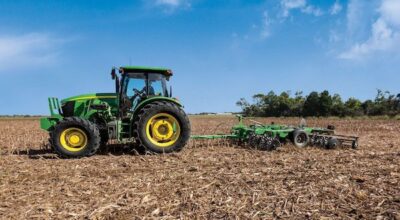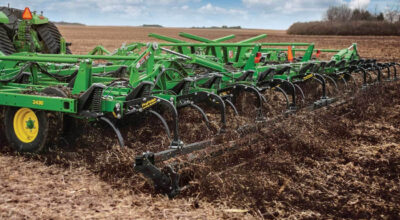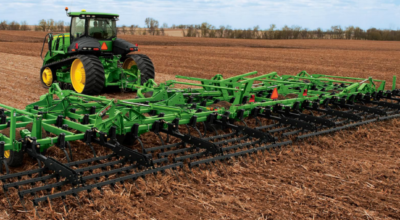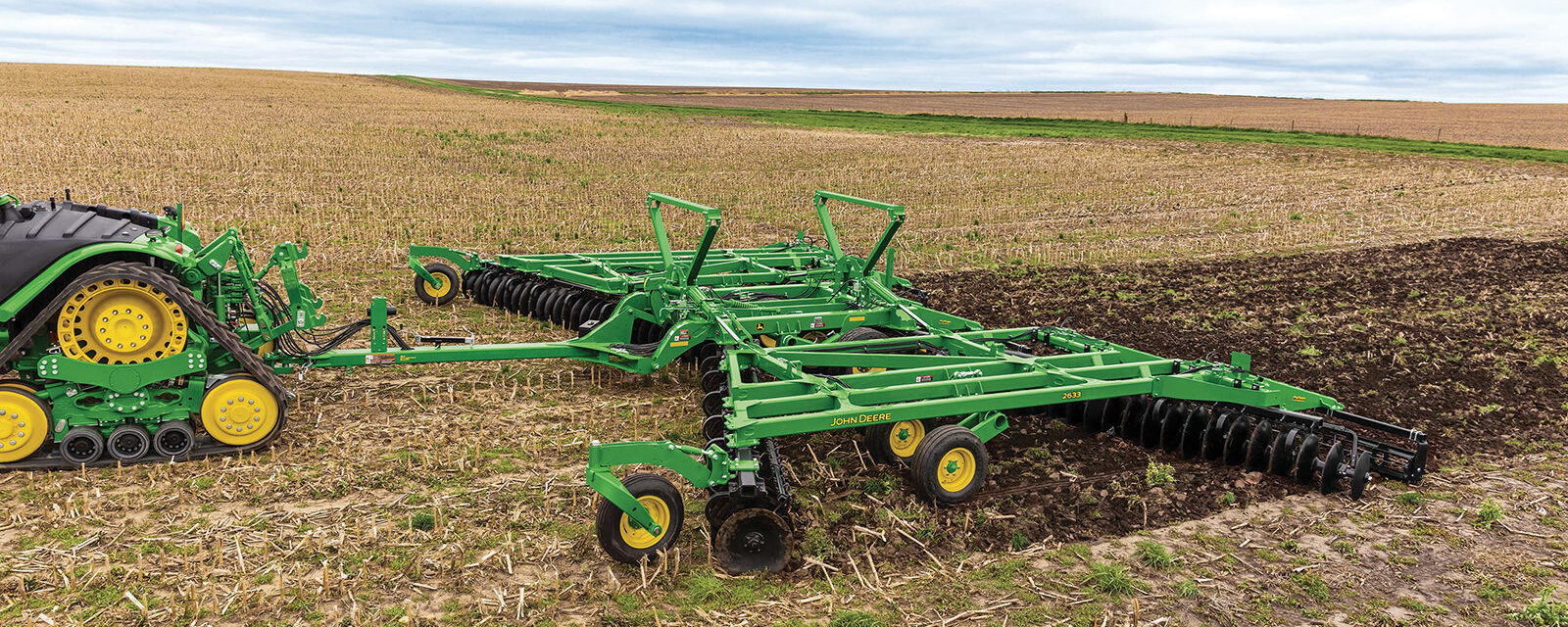
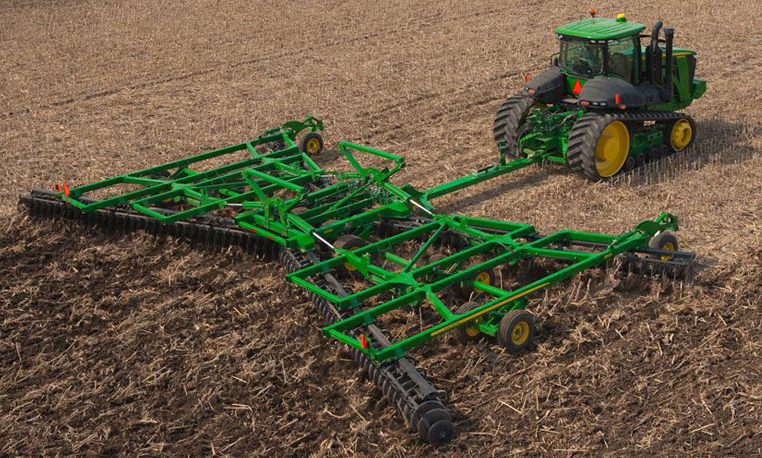
Once the combine leaves the field, stalks, leaves, and other crop residue remain. A John Deere disk harrow can cut and mix that residue while preparing the soil for the next operation.
Fall conditions affect how aggressively a field should be worked. Heavy residue may require more mixing, while soil moisture can influence working depth and tillage intensity.
Choosing the right disk harrow comes down to the desired result. Residue levels, soil conditions, working depth, acreage, and available tractor power all help determine which disk and setup make sense for the job.
Key Takeaways
- Fall disking can size and distribute crop residue while preparing the field for the next pass.
- Working depth should reflect how much residue incorporation and soil movement the field requires.
- Disk harrow configuration affects residue flow, soil mixing, and the resulting field finish.
- Working width and operating speed should be balanced with acreage and available tractor power.
- Conventional and high-speed disk harrows differ in operating speed, tillage intensity, tractor requirements, and potential field capacity.
How Do Disk Harrows Fit Into Fall Field Preparation?
A disk harrow uses rotating blades to cut crop residue and work the soil. After harvest, a disk harrow can size and distribute residue, mix plant material into the soil, and prepare the field for another tillage pass or spring planting.
The required tillage intensity depends on the field conditions. Lighter, evenly distributed residue may need only shallow tillage, while heavier residue may require greater incorporation and soil mixing.
That makes it important to define what the pass needs to accomplish, whether that’s sizing residue, incorporating more material, or preparing the field for the next operation.
What Are You Trying to Accomplish With Fall Tillage?
Start with the result the pass needs to produce. Residue sizing, residue mixing, and residue incorporation are related but distinct goals. Identifying the primary objective can help determine the appropriate disk configuration, depth, and operating speed. Sizing and redistributing residue may require less tillage intensity than incorporating more material and mixing the soil.
Consider where the disk harrow fits in the full tillage plan. Some operators may complete fall field preparation in one pass, while others use a disk before another fall operation or spring fieldwork.
What to Consider When Choosing a John Deere Disk for Fall
Once the tillage goal is clear, several field and equipment factors can help narrow down the right John Deere disk harrow, including:
- Soil conditions
- Crop residue
- Tillage depth and soil disturbance
- Working width and field productivity
- Tractor compatibility and horsepower
Soil Conditions
Soil type affects blade penetration and soil movement. Lighter soils may require less aggressive tillage, while medium or heavier soils can require changes in working depth or setup.
Moisture matters, too. Working excessively wet soil can increase the risk of compaction and smearing, potentially affecting soil structure.
Crop Residue
Residue type and volume determine how much cutting, mixing, and incorporation a field may need. Thick corn stalks, for example, can require more aggressive sizing and mixing than lighter residue that’s already distributed across the surface.
The right approach also depends on how much residue should remain after the pass. Whether the goal is to size, mix, or bury more material, operators should consider the next crop and broader tillage plan to manage residue in ways that best support soil health.
Tillage Depth and Soil Disturbance
Tillage depth should reflect how much residue and soil need to be moved. A deeper pass can increase residue incorporation and soil mixing, but may add unnecessary disturbance when the goal is surface residue management.
Disk setup also affects residue incorporation, soil movement, and field finish. Operators should evaluate that finish against the tillage or planting operation that follows.
Working Width and Field Productivity
Disk harrow width should match acreage, field layout, and available tractor power. Wider implements can benefit larger, open fields, but can be less practical in smaller or tighter fields.
A wider disk can cover more acres per pass, but also increases tractor demand. The right width gives operators the field capacity they need while staying within the tractor’s capabilities.
Tractor Compatibility and Horsepower
Tractor compatibility goes beyond the recommended tractor horsepower and drawbar capability. Traction, ballast, and available drawbar capacity also affect the tractor’s ability to pull and control the implement.
Power demand can increase with deeper tillage, higher speeds, greater implement width, and tougher soil. The tractor needs enough capacity to handle those demands without sacrificing consistent depth or field performance.
Comparing John Deere Disk Options for Fall Tillage
John Deere disk harrow options range from conventional tandem disks such as the 630, 637, and 2630 to newer HSD models, all of which are available on the used market.
The main differences involve tillage intensity, operating speed, tractor requirements, and field capacity.
Conventional vs. High-Speed Disks: Which Fits the Field?
Neither design is automatically better for fall tillage. Conventional and high-speed disks differ in soil movement, residue management, operating speed, and field capacity. High-speed disks are commonly operated at shallower depths and higher ground speeds than conventional tandem disks, allowing producers to emphasize residue sizing and field productivity.
| Consideration | Conventional Disks | High-Speed Disks |
| Desired tillage intensity | Soil and residue mixing with adjustable depth and configuration. | Higher-speed cutting and mixing designed for greater field capacity. |
| Crop residue | Suited to a range of residue levels depending on depth and configuration. | Effective for sizing and mixing heavier residue at higher speeds. |
| Operating speed and productivity | Traditional tillage speeds, with field capacity tied closely to implement width. | Higher speeds can cover more acres within a limited fall window. |
| Tractor requirements | Power needs depend on width, depth, and field conditions. | Higher operating speeds and wider configurations can require more tractor power. |
| Acreage and field layout | Practical for varied field sizes, layouts, and tillage programs. | May suit larger, open fields where higher operating speeds can increase field capacity. |
Higher operating speeds can increase field capacity only when the tractor, disk, and field conditions can support them.
Compare John Deere Disk Models and Generations
Compare these John Deere disk harrow models by configuration, tractor requirements, and potential fall-tillage use.
| John Deere Disk | Disk Type / Generation | Working Width / Configuration | Key Selection Considerations | Potential Fall Tillage Fit |
| 2630 | Tandem disk | Multiple widths and configurations | Working depth, residue level, tractor capacity, configuration | General-purpose tillage for incorporating residue and mixing soil |
| 630 | Earlier-Generation Conventional Tandem Disk | Varies by used configuration | Width, blade wear, gang condition, tractor match | Traditional soil and residue mixing where used-equipment condition is an important factor |
| 637 | Later-Generation Conventional Tandem Disk | Multiple configurations | Width, blade spacing, depth, tractor capacity | Varying residue and soil conditions that call for conventional tillage |
| HSD 25 | High-speed disk | Approx. 25-ft. class | Speed, horsepower, acreage, transport | Faster residue sizing and soil mixing where productivity is a priority |
| HSD 35 | High-speed disk | Approx. 35-ft. class | Horsepower, acreage, field size, speed | Larger acreages where greater field capacity can help move fall tillage along |
| HSD 42 | High-speed disk | Approx. 42-ft. class | Available power, field capacity, transport, residue | High-acreage operations that can put broader coverage to use |
| HSD 45 | High-speed disk | Approx. 45-ft. class | Horsepower, field layout, transport access, acreage | Large-scale operations with the tractor capacity for a wider disk |
More width or speed doesn’t automatically make a disk a better choice. Operators still need to account for tractor capacity, acreage, field layout, and tillage requirements.
When comparing used John Deere disk harrows, evaluate condition alongside the model number. Blade wear, gang condition, and configuration differences can affect how two listings of the same model perform in the field.
Find the Right John Deere Disk Harrow for Fall Tillage
Before buying a disk for fall tillage, define the field finish, residue management, and field capacity the operation requires.
Through MachineFinder, operators can compare John Deere disk harrows across models and generations, from conventional disks to newer high-speed options. Compare listings based on tillage requirements, tractor compatibility, configuration, and equipment condition, not just width alone.
Ready to tackle fall tillage? Explore John Deere disk harrows on MachineFinder and connect with your local John Deere dealer to discuss equipment condition, tractor compatibility, and options that fit your fall field needs.
John Deere Disk Harrows FAQs
1. When Should a Disk Harrow Be Used Instead of Another Type of Tillage Equipment?
A disk harrow is commonly selected when residue sizing, mixing, and seedbed preparation are desired in the same pass. Other tillage tools may be better suited for deep compaction management, vertical tillage, or lower-disturbance residue management.
2. How Does Operating Speed Influence Disk Performance and Field Finish?
Operating speed affects residue cutting, soil movement, and field finish. Higher speeds can also increase field capacity, but operating requirements depend on the disk design, field conditions, and available tractor power.
3. What Should Producers Consider When Matching Disk Size to Total Acreage?
Larger acreages may call for a wider disk, but field layout, operating speed, and tractor capacity determine whether that added width will actually increase field capacity.
4. How Can Blade Wear Affect Tillage Consistency and Residue Management?
Worn blades can reduce soil penetration and residue-cutting consistency. When comparing used equipment, checking blade condition can give operators a better idea of how well the disk will maintain depth and manage residue across the field.
5. How Does a Disk Fit Into a Broader Fall-to-Spring Tillage Plan?
A fall disk pass can prepare the field for another tillage operation or for spring fieldwork. Its role in that plan should determine how much residue is incorporated, how much soil is moved, and the finish left behind.