On many jobsites, crews need to dig, lift, or clear material without losing time to the wrong equipment choice. Deciding between a backhoe versus excavator directly affects crew efficiency, site mobility, and how well the machine performs in changing ground conditions.
Both machines play a major role across construction, utility, agricultural, and landscaping environments, and John Deere’s equipment lineup includes models built for dependable performance in each category.
This guide breaks down the key differences between backhoes and excavators, outlines the most common applications for each, and helps operators determine which machine best fits their worksite needs.
Key Takeaways
- A backhoe loader combines a front loader bucket with a rear digging arm, giving operators a versatile machine suited for small to mid-sized jobsites.
- An excavator is a dedicated digging machine with stronger power, reach, and control, making it ideal for large-scale earthmoving and demolition.
- Factors like job type, terrain, travel distance, and attachment needs play a role in determining which machine is the more efficient choice.
- John Deere offers a full range of backhoes and excavators engineered for durability, operator comfort, and reliable performance across industries.
What Is a Backhoe?
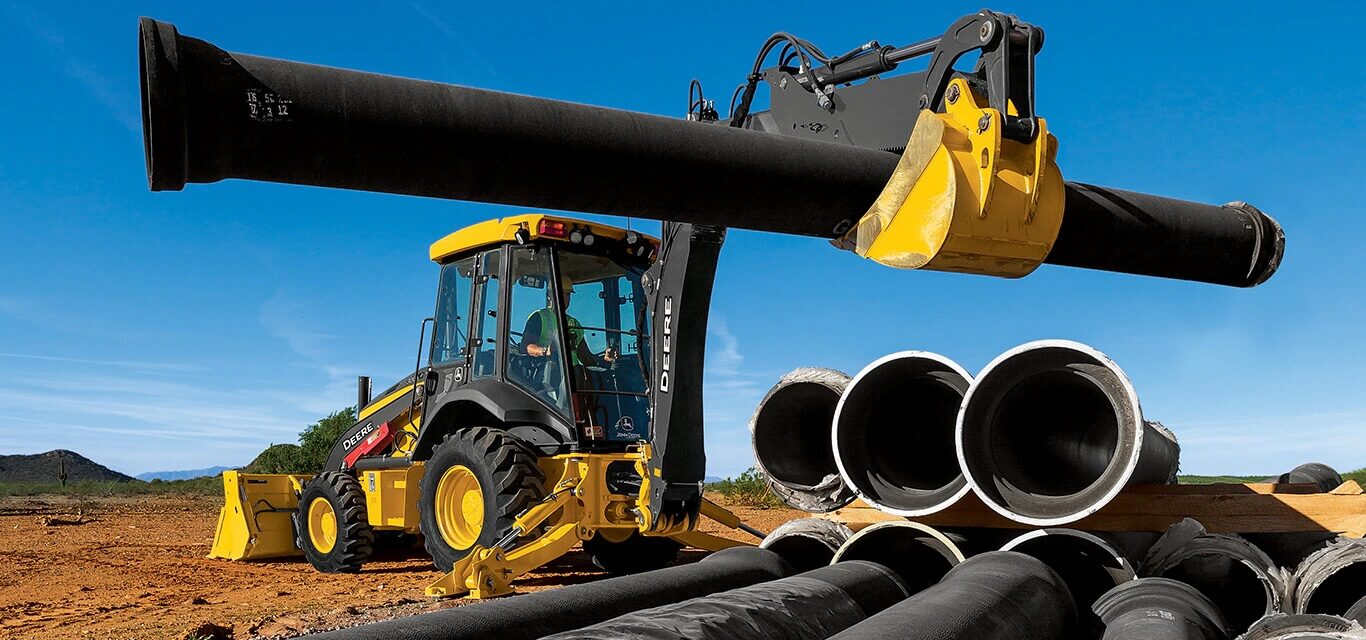
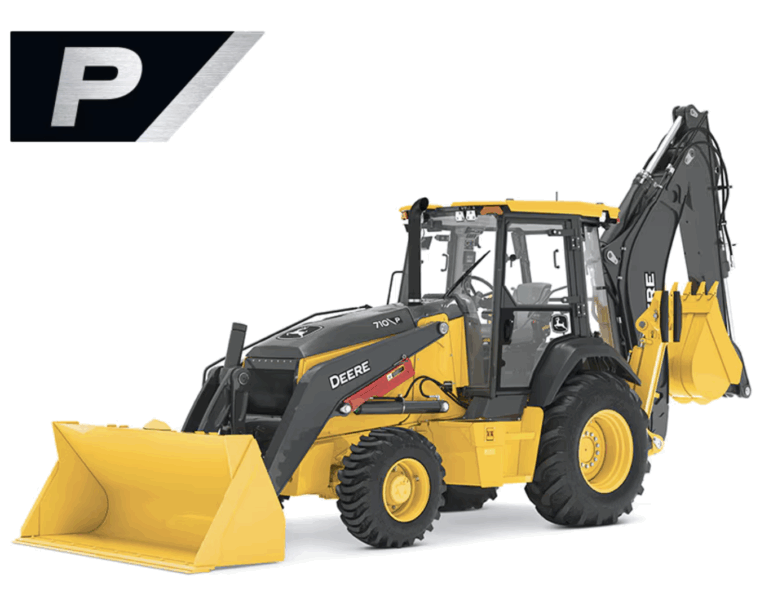
A backhoe loader combines two essential tools in one machine: a front loader bucket for moving and loading material, and a rear backhoe boom for digging, trenching, and excavation.
This dual-purpose design reduces downtime by allowing operators to switch between tasks quickly, making a construction backhoe especially valuable on small- to mid-sized jobsites that require versatility.
Some John Deere backhoe models include:
- 310 P-Tier Backhoe Loader: The 310 P-Tier is a basic model built for dependable digging and loading, with refined hydraulics and solid load capacity that make it a practical choice for routine construction and utility work.
- 710 P-Tier Backhoe Loader: A heavy-duty option built for demanding worksites, the 710 P-Tier delivers higher horsepower and greater digging depth, making it well-suited for larger jobs.
Common Backhoe Uses
Common backhoe uses include:
- Landscaping and property work: A backhoe loader can easily move soil and gravel, grade surfaces, dig small features, and remove stumps, making it a practical, multi-task tool for landscaping and property maintenance.
- Utility installation and repair: A backhoe loader’s rear arm can dig trenches for water, electrical, and drainage lines while the front loader streamlines backfilling and site cleanup.
- Road maintenance and municipal projects: Crews can rely on a construction backhoe to repair pavement, clear roadside material, and navigate between different maintenance locations.
- Construction tasks on smaller sites: A backhoe loader can dig footings, move aggregates, and perform light demolition, giving crews a single machine for multiple phases of daily work.
What Is an Excavator?
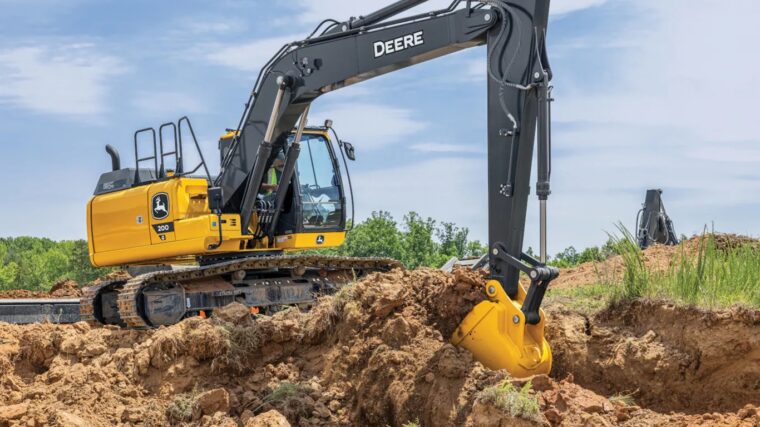
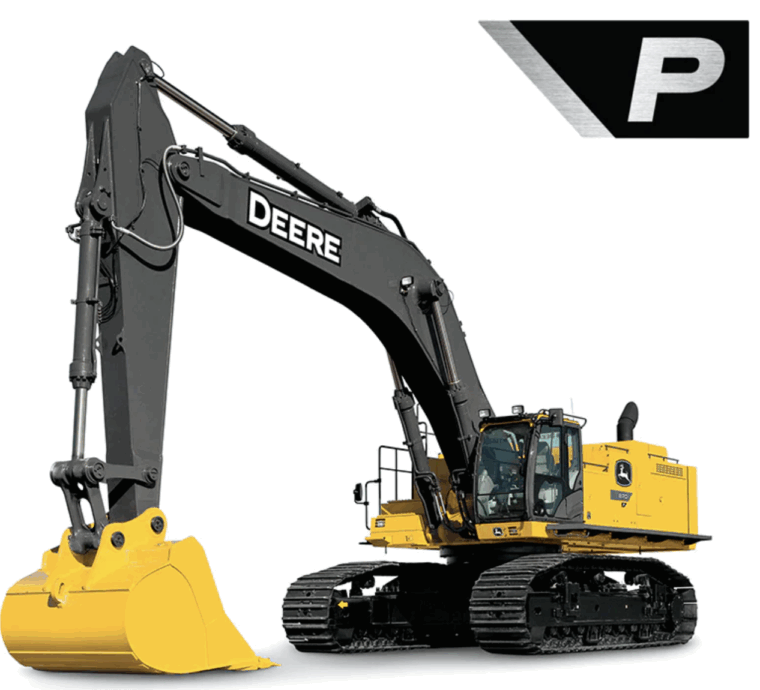
An excavator is a purpose-built digging machine with a rotating upper structure, a boom-and-stick assembly, and a bucket or specialized attachment. Operators can choose between tracked excavators, which provide added stability and traction on rough terrain, and wheeled excavators, which offer greater mobility on paved and urban worksites. In either configuration, powerful hydraulics and extended reach allow it to handle demanding tasks such as demolition and large-scale site clearing.
Some John Deere excavator models include:
- 35 P-Tier Compact Excavator: Compact and agile, this excavator is a strong fit for residential and utility work, designed for congested spaces where accurate digging and careful maneuvering are essential.
- 200 G-Tier Mid-Size Excavator: As a mid-size model, the 200 G-Tier pairs solid digging power with efficient fuel use, supporting foundation excavation, grading, and everyday earthmoving across busy jobsites.
- 870 P-Tier Large Excavator: The 870 P-Tier delivers the hydraulic power and digging reach needed for deep cuts, mass excavation, and large-scale site preparation. Its size and capability make it a strong fit for mining and heavy civil work.
Common Excavator Uses
Common excavator uses include:
- Foundation and structural excavation: Excavators dig deep pits and footings for buildings and infrastructure, supporting the earliest stages of construction.
- Pipeline and utility trenching: Long, consistent trenches can be created for water, sewer, and pipeline installation, maintaining precision even in tough soil.
- Land clearing and site preparation: Excavators remove brush, stumps, and debris while shaping terrain for roads, pads, or future building areas.
- Demolition and heavy lifting: With the right attachments, an excavator is capable of breaking concrete, removing structures, and lifting heavy materials that smaller machines can’t manage.
Backhoe vs. Excavator: Key Differences
Backhoes and excavators are often mentioned together, but they’re designed for distinct roles on a jobsite. Backhoes shine on multi-task jobs where versatility and mobility matter most, while excavators lead the way on large-scale projects that demand deeper digging power, stronger lift capacity, and consistent excavation performance.
From size and mobility to digging power and versatility, understanding where they differ helps operators choose the machine that truly fits their jobsite needs. The following chart breaks down these key differences:
| Feature | Backhoe | Excavator |
| Size | Compact to mid-sized; suitable for smaller worksites | Larger; built for intensive digging and lifting |
| Versatility | Loader and backhoe functions in one machine | Dedicated digging and lifting performance |
| Mobility | Often road-capable for short distances when following local safety regulations | Usually requires transport between sites using a trailer or low-loader |
| Attachments | Buckets, pallet forks, hammers, augers, rakes, snowplows, spreaders, thumbs | Quick couplers, plate compactors, construction hammers, rotary cutters, mulching heads, planetary drive augers, hydraulic thumbs |
| Digging depth | ~14–17 ft. | Over ~30 ft. |
| Best for | Utility work, roadwork, landscaping, small construction | Excavation, demolition, large-scale construction |
How to Choose the Right Machine for Your Job
Deciding between a backhoe and an excavator ultimately comes down to the demands of the jobsite. Take these factors into consideration to help you choose the most efficient and practical option:
- Job size and scope: Smaller or mixed-task projects often benefit from a backhoe’s versatility, while larger jobs typically require the deeper digging power of an excavator. For example, a backhoe is an efficient choice when crews need to dig shallow utility trenches and load material on the same site.
- Terrain and mobility needs: A backhoe can travel short distances on public roads when permitted, while a tracked excavator offers stronger stability and traction on uneven or soft ground. An excavator becomes especially useful on sites with muddy conditions or steep grades.
- Attachment and task requirements: Backhoes support a broad range of general-purpose attachments, whereas excavators accommodate specialized tools for heavy digging, demolition, or lifting. Projects requiring a hydraulic breaker, for instance, are more likely to favor an excavator.
- Transport and logistics: Moving an excavator generally requires a trailer, but a backhoe can reduce transport needs depending on the distance between worksites and local regulations.
Backhoe vs. Excavator: Making the Smart Choice with John Deere
Both backhoes and excavators deliver strong performance on a variety of tasks. The right choice depends on your project’s demands, the terrain you’re working on, and whether you need all-around versatility or dedicated digging power.
John Deere’s lineup of backhoes and excavators give operators reliable options for everything from utility trenching and site prep to deep excavation and heavy construction.
Ready to find the right machine for the job? Visit your local John Deere dealer or explore MachineFinder online to find the backhoe or excavator that fits your needs.
Backhoe vs. Excavator FAQs
1. What’s the Difference Between a Backhoe and an Excavator?
A backhoe combines a front loader and a rear digging arm, giving operators one machine that can switch between material handling and light-to-moderate excavation.
An excavator, by contrast, has only a digging boom and stick mounted to the front of a rotating upper structure, which is built for deeper digging power and stronger breakout force.
2. When Should I Use a Backhoe vs. an Excavator?
A backhoe is the better choice when a job requires versatility, such as digging, loading, and backfilling within the same area. An excavator is more suitable when the work calls for greater digging depth, heavier lifting, or continuous excavation on larger sites.
3. Is a Mini Excavator Considered a Backhoe?
No — a compact or mini excavator is still an excavator. Unlike a backhoe, which includes both a rear digging arm and a front loader, a mini excavator is designed solely for digging and maneuvering in tight spaces.
4. How Fast Can a Backhoe Go?
Many backhoes are designed to travel at road-safe speeds depending on the model, often around 20–25 mph.
5. Can You Excavate With a Backhoe?
Yes, a backhoe can perform excavation work, but an excavator will typically offer more depth, reach, and efficiency when the job calls for heavier digging.